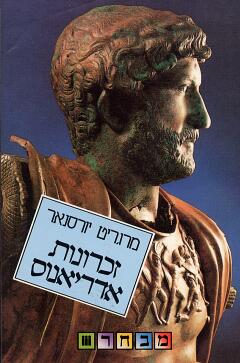
This is perhaps the most complex book I have read in a while.
Originally written in French, the hebrew translation I read uses a language, while not archaic per se, but somewhat poetic, long sentences complicating further what are already deep and, dare I say, philosophical concepts.
The book is written as a series of letters from the Emperor Hadrianus to his adopted grandson Marcus Aurelius (yes, that one).
From the very beginning Hadrianus lays down his creed about human nature, explains his love for all things Greek and his own character as an eternal optimist - not for its own sake but for the feeling of freedom it provides.
He writes a bit about his childhood and youth spent in the army, and as soon as anything, he is already 40 years old, awaiting, without much patience or hope, to be adopted and declared heir to the throne, while fighting yet another war against Parthia. Caesar, Crassus, my favourite Ancient Romans, had an obsession with this country. It was nice to see it persist through the years.
Hadrianus was the lucky one - his rivals had the same chances at power as him, the same hopes and dreams. Had their ''autobiographies'' been written, they would have been filled with them, all unfulfilled.
He is lucky - the ultimate power was his at last, and while he himself claims to be a bit of a philosopher, a bit of a dreamer, his approach to politics is very realistic.
He wants, and works for, a universal peace and he wants a universal Rome (in the existing borders) and he believes that he needs to work with humanity and that, by application of comon courtecy, potential enemies will be such no longer.
I liked how Hadrianus is cynical and amusing.
It was after, but feels like before.
Because he's writing a personal letter to his grandson, he is a stranger to false modesty and prevarication. He is honest about his shortcomings as he is about his virtues.
The whole saeculum aureum of Hadrianus, the golden age - meeting the love of his life, 5 years filled with overwhelming joy, of love and fun and travel, coming to an abrupt, but should have been predictable, end, was the saddest, most heartbreaking chapter I have ever read.
They may keep their bodice-rippers.
"My hand passed over his neck, under his heavy hair; thus even in the dullest or most futile moments I kept some feeling of contact with the great objects of nature, the thick growth of the forests, the muscular back of the panther, the regular pulsation of springs; but no caress goes so deep as the soul."
This is the most romantic thing I've read in a while.
Hadrianus, as he is the first to testify, comes across as a man of contradictions - a modest man who wants nothing more than to be an Emperor; a man with many lovers who loved only once; a Greek philosopher who was always a Roman pragmatist.
It's a very complex, very subtle book.
There's no conventional plot, nor action or romance or intrigue.
And yet, they are all there, but as a larger part of who Hadrianus is, rather than what surrounds him (if that makes any sense).
A human life in 300 pages. An exceptional accomplishment, no doubt an inspiration to many others.
There were pages difficult to read at times, when I was tempted, again, to pull a Joey.
Especially after.
It is impossible to read, nay, to relive with the character, such love and remain unmoved.
I found myself pausing for long seconds, just staring into space...
But just as Hadrianus had somehow found the strenght to go on, surely we, the reader, must as well.
And so the Jew uprising could not have come at a better time.
On a personal note, while I never agreed with their religious fanaticism, I felt strangely proud of my ancestors from Judea, who gave this peace-loving Emperor, against whom no nation dared stand, such a headache.
The Bar Kokhba rebellion had terrible consequences to the lives of Jews for a thousand years, still felt today, but I think that, even knowing the outcome for sure, they would have done the same thing again, for a chance to be free.
In the end, I think Hadrianus was surprised, just as the reader was, to discover that at some point, during or after, his life of wars and of peace, of travels, of parties, of intrigues, of laws, of rule, of health and of sickness, has narrowed down to only one "he".