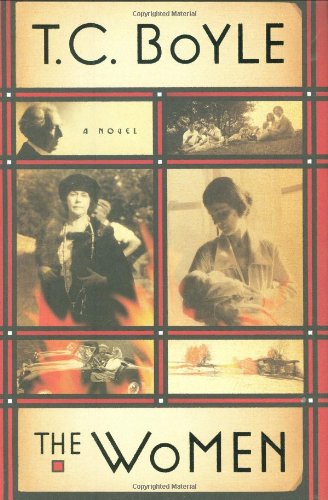
What made the craft of this book so noteworthy is the decision to tell the story in reverse chronological order and the entire book final chapter leaves you gasping for breath. The story of Mamah Borthwick is a stirring, horrifying account of that tragic incident and when depicted last makes everything that preceded it even more appalling.....
Is there any architect of the twentieth century more iconic than Frank Lloyd Wright, or any work of architecture more iconic than Taliesin, Wright's Wisconsin home? In THE WOMEN, author T.C. Boyle offers a unique view of the man, if not his work, by seeing him through the lens of his turbulent relationships with four different wives (legal and common law).....
Boyle divides the book into three sections corresponding to his last three marriages. He opens with Wright's last relationship with Olga Lazovich Hinzenburg, for whom he left the mercurial, morphone-addicted (Maude) Miriam Noel. Boyle tells Olgivanna's story in normal chronological sequence, but he forces us to look backward through Wright's life to imagine how he reached this point. The second section of the book traces the architect's tortured infatuation and tortured love affair with Miriam after the death of his second wife, Mamah Borthwick Cheney. The third and final section presents Wright's abandonment of his first wife Catherine (Kitty) Tobin, with whom he had six children, for the fiercely independent Mamah, culminiating with the tragic circuimstances that led to her death.....
The man who emerges is a seething bundle of contradictions, intensely loving but emotionally distant, consumed by the women in his life but ignoring them to non-existence when consumed by his work. In Boyle's rendition, Wright is the most self-certain of geniuses, never doubting that the world owed him obeisance and the perquisites that came with it. Rules, laws, and social mores applied to lesser humans. With his cult following of architect interns, he is the master of ceremonies and center of attention, pontificating endlessly on whatever crossed his mind and ruling his young subalterns' lives with an autocrat's iron fist. His relationship with the press is presented similarly, a self-contradictory desire for both private seclusion and public worship. The latter is best represented in Boyle's book by Wright's fascination with large, powerful automobiles painted in outrageously loud reds or yellows, affording him instant recognizability wherever he went. As a man ahead of his times, perhaps Wright was unconsciously or otherwise among the first to sense the male sexual connotations of oversized, powerful cars.....
Architecture in THE WOMEN is presented largely through Wright's Taliesin home; most of the rest of his work is mentioned or alluded to but never described. Thus, Taliesin serves the dual purposes of representing Wright's indisputable architectural genius while being the focal point of the relationships with the women in his life, primarily his mother to his wives. Just as his marital relations repeatedly go up in flames (with Wright himself invariably setting the fires), so does his beloved Taliesen suffer similar consequences on more than one occasion.
T.C. Boyle's fictional biographical approach in THE WOMEN works exceedingly well, portraying an artistic genius through his most human of relationships. Working backward through those marriages was a marvelous choice as well, providing a future context to each new, but earlier, love. One narrative choice, however, seems not only excessive but distracting: the use of one of Wright's interns, a young Japanese architect named Sato Tadashi. Sato is writing this story in 1979, much later in his own life, and ostensibly from memory. His voice presumably adds a Japanese perspective to Wright's life, which was itself heavily influenced by Asian art and cultural precepts. Regrettably, Tadashi offers little of use, and Boyle's use of footnotes to present Tadashi's stage-like asides are more annoying than complementary.....
.....
Outstanding Masterpiece of Literary Genius.....