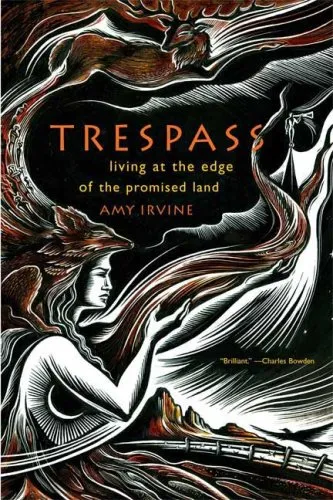
"Trespass might as well be Desert Solitaire's literary heir . . . It's hard to imagine a personal history more transporting that this one."—Judith Lewis, Los Angels Times Book Review Trespass is the story of one woman’s struggle to gain footing in inhospitable territory. A wilderness activist and apostate Mormon, Amy Irvine sought respite in the desert outback of southern Utah’s red-rock country after her father’s suicide, only to find out just how much of an interloper she was among her own people. But more than simply an exploration of personal loss, Trespass is an elegy for a dying world, for the ruin of one of our most beloved and unique desert landscapes and for our vanishing connection to it. Fearing what her father’s fate might somehow portend for her, Irvine retreated into the remote recesses of the Colorado Plateau—home not only to the world’s most renowned national parks but also to a rugged brand of cowboy Mormonism that stands in defiant contrast to the world at large. Her story is one of ruin and restoration, of learning to live among people who fear the wilderness the way they fear the devil and how that fear fuels an antagonism toward environmental concerns that pervades the region. At the same time, Irvine mourns her own loss of wildness and disconnection from spirituality, while ultimately discovering that the provinces of nature and faith are not as distinct as she once might have believed.
Formerly a nationally ranked competitive rock climber, Amy Irvine was for five years the Development Director at the Southern Utah Wilderness Alliance. Winner of the Orion Book Award A wilderness activist and apostate Mormon, Amy Irvine sought respite in the desert outback of southern Utah’s red-rock country after her father’s suicide, only to find that she was more of an interloper among her own people than she believed. But more than an exploration of personal loss, Trespass is an elegy for the ruin of one of our most beloved and unique desert landscapes and for our vanishing connection to it.
Fearing what her father’s fate might somehow portend for her, Irvine retreated into the remote recesses of the Colorado Plateau—home not only to the world’s most renowned national parks but also to a rugged brand of cowboy Mormonism that stands in defiant contrast to the world at large. Her story is one of ruin and restoration, of learning to live among people who fear the wilderness the way they fear the devil and how that fear fuels an antagonism toward environmental concerns that pervades the region. At the same time, Irvine mourns her own loss of wildness and disconnection from spirituality, ultimately discovering that the provinces of nature and faith are not as distinct as she once might have believed. “As raw and stinging as a fresh burn . . . It’s hard to imagine a personal history more transporting than this one, with its rigorously original prose (not a single cliché in 300-plus pages), emotional detail and bibliophilic departures into the musty caverns of American history.”—Los Angeles Times “As raw and stinging as a fresh burn . . . It’s hard to imagine a personal history more transporting than this one, with its rigorously original prose (not a single cliché in 300-plus pages), emotional detail and bibliophilic departures into the musty caverns of American history.”—Los Angeles Times
“[Irvine] braids together threads of Mormon history, her own family’s stories and her quest for illumination, creating a singularly elegiac and astringent memoir of dissent.”—Chicago Tribune
"Southern Utah's mesmerizing landscape of rock, river and ruins has inspired at least one masterpiece, Edward Abbey's Desert Solitaire, which provides Amy Irvine with the epigraph for her fierce memoir, Trespass: 'Beware traveler. You are approaching the land of horned gods.' 'Beware' is the key word. Although there aren't many occupants of this beautiful but isolated area, most of them consider Abbey's pro-environment, anti-cattle ideas extreme. Irvine, who had worked for a key Southern Utah environmental advocacy group, seemingly understood what she was in for when she moved from Salt Lake City to Monticello, a small town in the heart of the region, to recover from her father's suicide and to be closer to her 'lion man,' an environmental attorney. She thought she might encounter hostility, but believed that her Mormon background, lapsed though she was, and the hunting skills she learned from her father would provide her with cover. Her friends were rightly skeptical. How much do the locals hate environmental advocates? A popular window decal shows the cartoon character Calvin 'urinating on the acronym of the Southern Utah Wilderness Alliance,' Irvine's employer. Irvine's attempt to fit in, as well as to enjoy and protect the beauty of canyon country, is the most vivid ground-level report from this war zone that I have ever read . . . What lifts Trespass beyond polemic and personal suffering is its structure. The book is divided into sections named for the periods of early habitation of the Southwest: Lithic, Archaic, Basketmaker, Pueblo. The narrative skips back and forth from the author's own history to those of the Mormon pioneers and the earliest natives. This gives Irvine the chance to compare coyotes, despised as predators by ranchers, to the polygamist Mormons of the 19th century, who were 'truly coyotelike in their survival skills' and who claimed virtually the same habitat. She argues that early hunter-gatherers damaged the fragile land less than did the later agricultural Anasazi (the architects of wondrous places such as Mesa Verde), whom she describes as descending into decadent, over-populous cults and cannibalism. Similarly, Irvine suggests, contemporary culture is trying the patience of Mother Nature. During the recent drought, Lake Powell, the artificial reservoir that drowned the majestic Glen Canyon and then became a boating haven for families like hers, has receded so much that it shows a permanent 'bathtub ring' at its former high-water mark. Locals who swim in it become ill from the sewage. In the end, the author and the 'lion man,' now her husband, chose to retreat. They moved to a more hospitable small town in Colorado, where, in a bar, a cowboy bought them drinks even after learning they were professional environmentalists. Irvine found her sense of self to be more sustainable 'so near to the promised land and still so free of its grasp.'"—Grace Lichtenstein, The Washington Post Book World
“Amy Irvine is a new voice. Nine years went into writing Trespass, her first book. In that time she has learned her craft and honed it to a fine edge. Precious few books published today are written as well . . . It dawns on me that the best way to know if you want to read Trespass is to pull a copy off the shelf at your local bookstore and read the brief prologue. I am betting most of you will keep reading. A year or so ago I mentioned to a friend and mentor that I was reading and rereading the books of two women working in nonfiction: Ellen Meloy and Terry Tempest Williams. Their writing, I said, struck a different, sometimes more compelling, chord than the writing of men crossing m