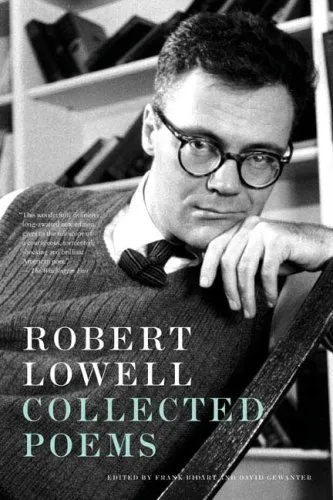
Frank Bidart and David Gewanter have compiled the definitive edition of Robert Lowell’s work, from his first, impossible-to-find collection, Land of Unlikeness; to the early triumph of Lord Weary’s Castle, winner of the 1946 Pulitzer Prize; to the brilliant willfulness of his versions of poems by Sappho, Baudelaire, Rilke, Montale, and other masters in Imitations; to the late spontaneity of The Dolphin, winner of another Pulitzer Prize; to his last, most searching book, Day by Day. This volume also includes poems and translations never previously collected, and a selection of drafts that demonstrate the poet’s constant drive to reimagine his work. Collected Poems at last offers readers the opportunity to take in, in its entirety, one of the great careers in twentieth-century poetry. A friend and colleague of such other important American writers as John Berryman, Elizabeth Bishop, Delmore Schwartz, Theodore Roethke, Peter Taylor, and Randall Jarrell, Robert Lowell (1917-77) was the renowned and controversial author of many books of poetry, including Day by Day, The Dolphin, For the Union Dead, Life Studies, and History. His Collected Prose was published by FSG in 1987.
Frank Bidart is the author of several works of poetry, including In the Western Night: Collected Poems 1960-90 and Desire. He teaches at Wellesley College.
David Gewanter is the author of two books of poems, In the Belly and The Sleep of Reason. He teaches at Georgetown University. A Los Angeles Times Best Book
A San Francisco Chronicle Best Book
Edmund Wilson once wrote that Robert Lowell was "the only recent American poet—if you don't count Eliot—who writes successfully in the language and cadence and rhyme of the resounding English tradition." And Randall Jarrell observed of him: "You feel before reading any new poem of his the uneasy expectation of perhaps encountering a masterpiece." He was the English-speaking world's preeminent postwar poet—a legend of modern letters.
In this long-anticipated, universally acclaimed collection, Frank Bidart and David Gewanter have compiled the definitive edition of Lowell's work, from his first, impossible-to-find collection, Land of Unlikeness; to the early triumph of Lord Weary's Castle, winner of the 1946 Pulitzer Prize (when the poet was 30 years old); to the brilliant willfulness of his versions of poems by Sappho, Baudelaire, Rilke, Montale, and other masters in Imitations; to the late spontaneity of The Dolphin, winner of another Pulitzer Prize; to his last, most searching book, Day by Day. This hefty volume also includes poems and translations never previously collected, and a selection of drafts that demonstrate the poet's constant drive to reimagine his work. Bidart, Lowell's longtime friend, apprentice, and literary executor, has here contributed an introduction and afterword that both explore Lowell's idiosyncratic approach to poem-making. Moreover, Collected Poems includes voluminous notes and a glossary of important names.
At last, all readers, scholars, and students are given the opportunity to take in, entire, one of the great careers in twentieth-century poetry. "Here is the long-awaited Collected Poems to prompt a reevaluation of what was always an asset-rich artistic enterprise . . . Frank Bidart and David Gewanter are tender and magnanimous to the poems. They devote a thousand sumptuous pages to most of those Lowell printed and give many drafts and variants in the voluminous notes. The persistent vigor and variety of [the poet's] creative energy is astonishing now that we see the whole career get its due."—Anthony Moore, The Boston Globe "More than anyone else, [Frank] Bidart has the intellectual authority to edit [Lowell's] Collected Poems, and he has now given us this extraordinary thousand-page book, handsomely annotated by himself and David Gewanter . . . Bidart's intimate introduction leads the reader to understanding, in Lowell, the relation of private to public, of original to revision; and in his brilliant 'Afterword: On "Confessional" Poetry,' [Bidart] draws all the right distinctions between art and life . . . Lowell was . . . a markedly intelligent and resourceful poet of war, politics, and personal analysis; but he was also a fascinating poet of love, sex, and contemporary marriage . . . It is Lowell's boldness in returning life's gaze . . . that distinguishes the stunning poems that are collected here."—Helen Vendler, The New Republic
"[Bidart's] introduction (quite properly) doesn't make a case for Lowell's pre-eminence as a 20th-century American poet, but stresses instead the editors' attempt to look at every published instance of a Lowell poem and to include, in their notes, versions and lines that appeared elsewhere than in the published volumes. It is good to have included, among many other things in the notes and appendixes, magazine versions of such central poems to the Lowell canon as 'Beyond the Alps' and 'Waking Early Sunday Morning' . . . This [is a] splendid edition."—William H. Pritchard, The New York Times Book Review
"Lowell, like Wordsworth and Auden, was a tireless and obsessive rewriter . . . Just assembling and sorting through the various texts was an exhausting editorial enterprise. Then, though this had not been part of the original plan, Bidart decided that [Lowell's] poems needed to be annotated. But finally what [kept] the Collected Poems [from appearing until twenty-five years after Lowell's death] was the same thing that kept Penelope at her loom. The longer Bidart worked on the project, the more reluctant he was to finish. 'I loved Lowell—he mattered enormously,' Bidart said recently. 'And in a funny way to end this book was like losing him all over again.' In fact the book restores him—not Lowell the basket case but Lowell the master. And the Collected Poems, if you read it more or less in chronological order, supplies another kind of biography, the story of how a great poet finds and then refines his voice."—Charles McGrath, The New York Times Magazine
"Here is the long-awaited Collected Poems to prompt a reevaluation of what was always an asset-rich artistic enterprise . . . Frank Bidart and David Gewanter are tender and magnanimous to the poems. They devote a thousand sumptuous pages to most of those Lowell printed and give many drafts and variants in the voluminous notes. The persistent vigor and variety of [the poet's] creative energy is astonishing now that we see the whole career get its due."—Anthony Moore, The Boston Globe
"A monument to [Lowell's] sprawling, untidy talent and his courageous attempts to make it cohere."—Sunil Iyengar, The Washington Post
"The part of Collected Poems that I treasure most is the Lowell of the 1960s: Imitations, For the Union Dead, and Near the Ocean. These volumes maintain a marvellous poise, alive to the pressures of the age yet refusing to cave in or dwindle into a rant. If anything, Lowell, a devotee of Virgil, Horace, and Propertius, hit upon a tone—a buoyant classical sternness—that had scarcely been heard since the eighteenth century. Somehow, he alone seemed qualified to capture the decade's mixture of light-footed private desires and dark public soothsaying, and to convey the urgency of both in lines