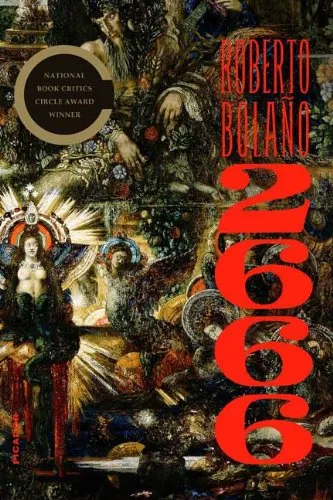
A NATIONAL BOOK CRITICS CIRCLE AWARD WINNER
New York Times Book Review 10 Best Books of 2008
Time Magazine's Best Book of 2008 Los Angeles Times Best Books of 2008
San Francisco Chronicle's 50 Best Fiction Books of 2008
Seattle Times Best Books of 2008
New York Magazine Top Ten Books of 2008
Three academics on the trail of a reclusive German author; a New York reporter on his first Mexican assignment; a widowed philosopher; a police detective in love with an elusive older woman--these are among the searchers drawn to the border city of Santa Teresa, where over the course of a decade hundreds of women have disappeared.
In the words of The Washington Post, "With 2666, Roberto Bolaño joins the ambitious overachievers of the twentieth-century novel, those like Proust, Musil, Joyce, Gaddis, Pynchon, Fuentes, and Vollmann, who push the novel far past its conventional size and scope to encompass an entire era, deploying encyclopedic knowledge and stylistic verve to offer a grand, if sometimes idiosyncratic, summation of their culture and the novelist's place in it. Bolaño has joined the immortals." Robert Bolaño was born in Santiago, Chile, in 1953. He spent much of his adult life in Mexico and in Spain, where he died at the age of fifty. His novel The Savage Detectives was named one of the best books of 2007 by The Washington Post, the Los Angeles Times, and The New York Times Book Review. Winner of the National Book Critics Circle AwardWinner of the PEN Translation PrizeA Los Angeles Times Favorite Book of the Year
One of The New York Times 10 Best Books of the Year
A New York Times Book Review Notable Book
Time Magazine's Best Book of the Year
One of The Washington Post 10 Best Books of the Year
A San Francisco Chronicle Best Book of the Year
A Seattle Times Best Book of the Year
A Village Voice Best Book of the Year
A Kirkus Reviews Best Book of the Year A Publishers Weekly Best Book of the Year
Three academics on the trail of a reclusive German author; a New York reporter on his first Mexican assignment; a widowed philosopher; a police detective in love with an elusive older woman—these are among the searchers drawn to the border city of Santa Teresa, where over the course of a decade hundreds of women have disappeared. Published posthumously, 2666 is, in the words of La Vanguardia, "not just the great Spanish-language novel of this decade, but one of the cornerstones that define an entire literature." "Bolaño was a difficult, angry, self-reflexive writer who lived an erratic and occasionally unpleasant life. And Americans, as the head of the Swedish Academy has annoyingly but rightly pointed out, don't read much fiction in translation anyway. But when the first of Bolaño's major novels, The Savage Detectives, a massive, bizarre epic about a band of avant-garde Mexican poets, was published in the U.S. last year, it instantly became a cult hit among readers and practically a fetish object to critics. Bolaño's second (and last) major novel is titled 2666, and if anything, it is even more massive and more bizarre. It is also a masterpiece, the electrifying literary event of the year."—Lev Grossman, Time "Well beyond his sometimes nomadic life, Roberto Bolaño was an exemplary literary rebel. To drag fiction toward the unknown he had to go there himself, and then invent a method with which to represent it. Since the unknown place was reality, the results of his work are multi-dimensional, in a way that runs ahead of a critic's one-at-a-time powers of description. Highlight Bolaño's conceptual play and you risk missing the sex and viscera in his work. Stress his ambition and his many references and you conjure up threats of exclusive high-modernist obscurity, or literature as a sterile game, when the truth is it's hard to think of a writer who is less of a snob, or—in the double sense of exposing us to unsavory things and carrying seeds for the future—less sterile . . . 2666 was published in Spanish in 2004, a year after Bolaño's death. It runs to 898 pages in English and was not quite finished—yet one doesn't really feel the lack of final revisions doing much to diminish its power . . . With his skill at letting small details and their implications work in our minds, Bolaño allows us to start to map out for ourselves the larger social pattern. From description, we could probably sketch the city of Santa Teresa, quadrant by quadrant, from upscale condos to sports fields to bus stops and shacks by a makeshift latrine. Factories beckon migrants from all over Mexico to work, but offer no transport home at night beyond long, solitary walks in the dark. A creepy German national—whose height and blond fairness give him, in the Mexican context, a rather monstrous aspect—is held on suspicion of murder. The worst police seem wired to power; the better police are under pressure to nab a suspect—and the crimes go on. Fascinatingly, the United States appears as a part of characters' remembered visits; a Mexican-American sheriff from Arizona crosses over to find out what happened to a blue collar woman from his town. But the United States's relationship to the drug trade and the history of the assembly plants are not explored directly or at length. Instead of belaboring the obvious, Bolaño seems to have chosen the challenge of representing something pervasive . . . Bolaño's vision is fierce . . . Near the end of the novel, we learn the reason Reiter is headed for Mexico. And then he is gone. Instead of completion we have the physical sense of being in the presence of a controlling object, which we are not yet done investigating. For a while yet, our brain feels rewired for multiplicity. This is not just a cultural or geographical question, though if 2666 contains a lesson it is that people are always from some confluence of factors more bizarre than a country. And it goes deeper than the question of multiple voices. We have eavesdropped on characters and then felt ourselves in the funny, sad, and dangerous process of needing and making meaning. Since there is no logical endpoint, we close with an image from the novel that is out of time. A world of 'endless shipwreck,' but met with the most radiant effort. It is as good a way as any to describe Bolaño and his overwhelming book."—Sarah Kerr, The New York Review of Books
"Shortly before he died of liver failure in July 2003, Roberto Bolaño remarked that he would have preferred to be a detective rather than a writer. Bolaño was 50 years old at the time, and by then he was widely considered to be the most important Latin American novelist since Gabriel García Márquez. But when Mexican Playboy interviewed him, Bolaño was unequivocal. 'I would have liked to be a homicide detective, much more than a writer,' he told the magazine. 'Of that I'm absolutely sure. A string of homicides. Someone who could go back alone, at night, to the scene of the crime, and not be afraid of ghosts.' Detective stories, and provocative remarks, were always passions of Bolaño's—he once d